
In 1974 the Journal of Political Economy published a five-page paper with an answer. The author was Alan Blinder, three years out of his PhD and teaching at Princeton. “The Economics of Brushing Teeth” starts from the assumption it attributes to all of human capital theory, that people act to maximize their income. It follows that each person does the amount of brushing that maximizes income. Full professors earn more per hour, so brushing costs them more and they do less of it. Assistant professors are waiting on promotion and cannot afford bad breath, so they do more. The evidence is a survey from the Journal of Dental Sociology, which does not exist, in which assistant professors brush 2.14 times a day and full professors 1.47. Its author, a sociologist, had attributed the difference to hygiene standards rising from one generation to the next, and the paper corrects him.
I went looking for this paper because I half remembered it. I had the title as something like “the economics of the toothbrush,” and I had it filed as evidence for a story I believed, that the leading economists of the postwar generation hated Gary Becker. In that story Samuelson had dismissed his work, Solow had opposed it, and Blinder, who was Solow’s student, had made fun of it in print.
The parody appeared in the journal edited in Becker’s own department at Chicago. According to James Heckman, whose “Private Notes on Gary Becker” I draw on throughout, Becker read it, said the analysis was interesting, and favored publishing it. Neither fact fits the story I had.
I kept thinking about the parody after I had the history straight, because I could not say what separates Blinder’s model from the ones that won Becker the Nobel Prize in 1992. Both start from maximization and apply it to behavior that economists had left to other fields, and both derive predictions and offer evidence for them. I could not point to the feature that makes one of them a joke.
The reception
Becker’s own account of his reception is blunt. In his Nobel autobiography he wrote that most of the leading economists had either paid no attention to his kind of work or disliked it intensely, and that this went on for a long time. At the banquet in Stockholm he said the prize recognized the economists who had put up with obstruction, criticism and ridicule in order to study behavior the field had left alone. His dissertation, published in 1957 as The Economics of Discrimination, already treated prejudice as a taste that an employer pays to indulge, at a time when most economists did not consider racial discrimination an economic subject.
An episode his Chicago colleagues often retold concerns his next subject. At an NBER conference whose proceedings appeared in 1960, Becker presented “An Economic Analysis of Fertility,” which treats children the way demand theory treats durable goods. Parents choose how many to have and how much to spend on each, given their income and the prices they face. One of the two discussants was James Duesenberry of Harvard, and his comment contains the line everyone remembers. He used to tell his students, he said, that economics studies how people choose and sociology studies why they have nothing to choose.
In the version usually told, Becker was attacked by Duesenberry and by much of the audience. Heckman notes that Friedman, Stigler and Becker brought the episode up often. He calls the violent attack an urban legend that may well be true, and then adds that the written record shows a discussant with useful objections. I read the comment, and Heckman is right. Duesenberry begins by crediting Becker with bringing economic analysis back to a subject that economists had taken as given. Then he points out that richer families in the data of the period had fewer children, while a model that treats children like durable goods predicts more. Becker’s answer was that poorer couples knew less about contraception. Duesenberry accepted part of that, said the evidence was less than overwhelming, and proposed that the explanation lay in what children cost. Children share their parents’ standard of living, he argued, and the time each child requires is set by the conventions of the family’s social class. Nobody in the room, he said, not even Becker, considered himself free to choose between two children who go to university and four who leave school after high school.
Becker worked on that objection for forty years. His 1973 paper with H. Gregg Lewis put the interaction between the number of children and spending per child into the budget constraint, and Heckman follows the same line of work through to Becker’s book with Kevin Murphy in 2000. Whatever happened in the room, the comment set much of the agenda for his later work on fertility.
Samuelson’s contempt is on the record. In 1976 he published a short paper built around Richard Easterlin’s account of fertility swings, which he praised. He set it against the usual way economists described fertility decisions, which he called sterile, written in an indifference-curve jargon that intimidated readers who had never studied utility theory. A footnote pointed to a survey of economists’ theories of fertility and named the Chicago School theorists Becker and T. W. Schultz. Solow, six years older than Becker, attended the same Brooklyn high school. Heckman describes him as Becker’s lifelong antagonist and says he tried to block publication of Becker’s theory of marriage. That claim rests on Heckman’s notes for a talk, and I have found no account of it from Solow’s side.
Even so, hated is too strong a word. Heckman was a graduate student at Princeton in the 1960s, and he recalls that the commentary of the time was not always favorable to Becker’s work and was always favorable to Becker, who was regarded as an eccentric, a bright man wasting his time on odd topics. The American Economic Association gave him the Clark Medal in 1967. The hostility was aimed at a research program, and much of the story of persecution comes from Chicago itself, from Becker’s Nobel speech and from Heckman, with whom I work.
Becker himself observed, in the preface to A Treatise on the Family, that many economists were hostile to an economic approach to the family while growing numbers of sociologists, anthropologists, lawyers and historians were adopting one. The sociologist whom the Journal of Economic Literature asked to review the book, Michael Hannan, judged it the most important book on the family in a long time.
Reading the critics side by side, I count four separate complaints, and only one of them bears on whether a model is right. One complaint was that the topics were not economics. Another was the vocabulary, with children compared to durable goods and schooling treated as an investment, a view that Becker later recalled was thought unfeeling and narrow. A third was political, and Barbara Bergmann put it most directly in 1995, when she wrote that Becker’s way of thinking about the family, in common with most neoclassical theory, ends by finding existing institutions harmless and government intervention pointless or damaging. The last was that the models could be made to explain anything, and it is the complaint Blinder wrote down.
The toothbrush model
Blinder’s paper is funny because nothing in it is wrong as economics. Time spent brushing has an opportunity cost and appearance plausibly affects earnings, so a person who weighs the two will brush more when the cost is low and the payoff is high. The derivation is valid. I argued in “Economics Has No Lean” that checking whether a conclusion follows from its assumptions is the part of economics a machine can do, and that the check says nothing about whether the assumptions describe the world. A proof checker would pass the toothbrush model.
The paper opens by setting aside two rival accounts. One holds that people differ in their taste for brushing, and Blinder’s narrator rejects it because differences in taste can rationalize any behavior and therefore predict nothing. The other holds that people brush because their mothers told them to, which leaves unexplained why mothers care. Then comes the model. Income equals the wage times the hours left after brushing, plus unearned income, and the wage depends on the job and on the time spent brushing. Two implications follow from the first-order condition. A worker whose wage does not depend on brushing never brushes, and among jobs with the same payoff to brushing, the better paid brush less. The paper reports a regression with an R² of 0.79 and concludes that the data support the theory.
The parody cannot be dismissed, then, as a model that forbids nothing. It forbids several things, and it offers that as its advantage over the taste school. The model fails in a different way. Let me explain. Every implication holds the payoff to brushing fixed, and the payoff is never measured, only asserted. Twins in a chewing-gum commercial are said to earn more from a good smile than longshoremen do, which is plausible, and which the paper does not check. For professors the payoff runs through promotion. Had the survey come out the other way, I could have written the paragraph myself. Full professors sit on committees and meet deans and donors, so the payoff to fresh breath rises with rank. The pattern the model does predict is also the one the sociologist predicts, since rising standards of hygiene put the young ahead as well, and the survey cannot tell the two accounts apart. The R² measures how well the equation fits. It does not measure whether the fit would have been worse had people brushed for some other reason.
Robert Pollak gave me the vocabulary for this. Pollak has spent, by his own account, much of his career criticizing Becker, and in 2001 he was invited to a Chicago symposium in Becker’s honor with a request for a serious assessment in place of praise. The paper that came out of it separates two kinds of assumption in Becker’s work. The foundational assumptions are that people maximize and that their choices are reconciled in an equilibrium. When Becker set out the approach in The Economic Approach to Human Behavior in 1976 he listed a third, stable preferences, and later gave it up. Pollak’s observation is that the foundational assumptions are compatible with so wide a range of behavior that they have few refutable implications. The conclusions that made Becker famous come from additional assumptions, which Pollak calls auxiliary, about what people care about, how households produce what they consume, and how a family arrives at a decision.
In Pollak’s terms the toothbrush model has auxiliary assumptions of its own. Income is the only thing people brush for, and the wage rises with brushing by an amount that differs from job to job. The first is absurd. The second is never measured, and nothing in the paper puts it at risk.
Becker had seen the problem twelve years before the parody. In 1962, in “Irrational Behavior and Economic Theory,” he showed that the main prediction of demand theory does not depend on rational consumers. Take households that choose at random among the bundles they can afford, or that keep buying what they bought before for as long as they can. When the relative price of a good rises, with real income held roughly constant, the set of affordable bundles shifts away from that good, and the market as a whole buys less of it. The result holds on average and need not hold for each household. A result that economists had credited to maximization came from the budget constraint. In 1977, three years after the parody, he and George Stigler proposed a rule in “De Gustibus Non Est Disputandum.” Economists should treat tastes as stable and alike across people, and should never explain a difference in behavior by saying that tastes differ. The explanation has to run through prices and incomes. The rule removes the freest parameter in the model, and it is the rule Blinder’s narrator applies to the taste for brushing.
Pollak’s reply to the rule is brief. Stigler and Becker moved the unobserved differences from tastes to household technology, and for the purpose of explaining behavior an unobserved difference in technology does the same job as an unobserved difference in taste.
What a model forbids
My first answer to the puzzle was the textbook one. A just-so story explains a fact after seeing it, and a scientific theory predicts the fact before seeing it. Blinder wrote his model after the survey, so it is a just-so story.
That answer is too crude. It would condemn Becker’s fertility theory along with the parody, since the theory was built to fit facts already known and rebuilt after Duesenberry pointed to one it missed. Most of economics is written this way. Hitchcock and Sober (2004) propose that fitting a theory to known observations is a defective method only when nothing guards against overfitting. Anyone who has added regressors until the R² approached one knows the problem. The date of a theory matters only as a proxy for how much freedom the theory had to fit whatever turned up.
My second answer was falsifiability. A model has empirical content when it names an outcome that would count against it, so the question to ask is what the model forbids. That is the right question, and it still does not separate the parody from Becker. Blinder’s model forbids things, and its narrator uses the criterion himself against the taste school.
Two further questions separate them. The first is what the model forbids that we would otherwise expect to see. A prediction shared by every rival explanation cannot fail in an informative way, and its success tells us little. Econometricians call the missing property power. A test has power against an alternative only when the two would produce different data, and the survey of professors has none against the sociologist.
The second is what the model forbids given the assumptions it maintains. The added clause matters because no test reaches a model’s behavioral claims directly. They have to be joined to further assumptions before they say anything about data, and the data have to pass through a research design before they say anything about the model. Write F for the foundational assumptions, A for the auxiliary assumptions that make the particular model, and I for the assumptions that identify the estimate. A failed test is evidence against F ∧ A ∧ I taken together. It does not show which part failed, and because the test is statistical it does not prove that any part did. In practice F is rarely the part given up, so the choice usually lies among the model’s own mechanism, a more peripheral assumption inside A, and the research design. Philosophers call this the Duhem-Quine problem, and empirical economists call it a joint hypothesis.
The joint hypothesis works in both directions. It protects a model from quick dismissal, since a failed test may only have found a bad instrument. It also lets a determined defender keep the mechanism after any result, by giving up a peripheral assumption or by faulting the research design. The discipline lies in stating beforehand which assumptions are maintained, in measuring them without help from the model, and in keeping count of how often they are revised afterward. Blinder’s model fails at the second step. It maintains a payoff to brushing that it never measures and lets differ from one job to the next.
Three restrictions and what happened to them
With those questions I went back to three of Becker’s models and looked up what became of the restriction each one imposes. Let me be concrete about each.
Start with the dissertation. In The Economics of Discrimination some employers dislike employing Black workers and behave as if a Black worker’s wage were higher than it is. Black workers are hired first by the employers who dislike them least. If unprejudiced employers can absorb all of them, no wage gap appears, however much prejudice exists elsewhere in the market. If they cannot, the gap is set by the prejudice of the marginal employer, the most prejudiced one who still hires Black workers. The gap therefore rises with the prejudice of the marginal employer. It rises with the Black share of the workforce, because a larger share pushes the margin further into the distribution of prejudice. And the views of the most prejudiced employers have no effect on wages, since Black workers do not work for them.
The model could have been wrong. The natural expectation is that Black workers earn least where the average white resident is most prejudiced, and the model says the average adds nothing once the margin is known. According to Charles and Guryan (2008), nobody had tested these predictions in the half century since the book. They measured prejudice by state from the General Social Survey and took wages from the Current Population Survey. Black wages relative to white wages are lower where the white resident at the margin is more prejudiced and where the Black share of the population is larger. Prejudice in the lower tail of the distribution matters, and the prejudice of the most prejudiced adds nothing. By their estimate prejudice accounts for about a quarter of the racial wage gap. The test has maintained assumptions of its own, since a state stands in for a labor market and answers to survey questions stand in for the tastes of employers. I still count this as a restriction that could have failed and did not.
The second model made a prediction that failed. In “A Theory of Social Interactions” and later in the Treatise, Becker describes a family with an altruistic head who cares about the other members and transfers income to them. Two results follow. The Rotten Kid Theorem says that every member, however selfish, gains by acting to raise the family’s total income, because the head adjusts his transfers in response. The pooling result says that taking income from one member and giving it to another changes nobody’s consumption, because the head offsets the change. The second can be taken to data, because if a family pools its money it makes no difference which parent receives a government payment.
In the late 1970s the United Kingdom changed how it supported families with children. Much of the support had come as a tax allowance, which in practice usually meant through the father’s paycheck. The reform replaced it with a cash benefit paid to the mother. Opponents in the House of Commons complained that the scheme took a benefit away from fathers, so they at least expected the recipient to matter. Lundberg, Pollak and Wales (1997) compared household spending before and after, holding total expenditure constant, and found that spending on children’s clothing and on women’s clothing rose relative to spending on men’s clothing, which pooling rules out.
Before accepting the rejection I went through the conjunction, starting with identification. A before-and-after comparison assumes that nothing else was moving spending toward women’s clothing in those years. Hotchkiss (2005) repeated the comparison for married couples without children, whom the reform did not touch, and found that women’s clothing rose relative to men’s among them too, which would make part of the original result a trend. Ward-Batts (2008) went to household-level records and a wider set of goods. She found no comparable shift among childless couples, the opposite of Hotchkiss, and a movement of spending toward children and mothers in the families that received the benefit. Evidence from a different country and a different design points the same way. Duflo (2003) found that a South African old-age pension paid to a woman improved the weight and height of the girls in her household. A pension paid to a man had no comparable effect.
The auxiliary assumptions come next, and the theorem had already been narrowed on theoretical grounds. Bergstrom (1989) showed that its conclusion fails unless utility is transferable within the family. The enlarged edition of the Treatise listed further conditions, among them a single time period, goods that can all be bought and sold, and parents who choose after their children do. Pollak remarks that the list looks assembled to exclude the known counterexamples. Each added condition makes the theorem true of fewer families. The evidence on pooling is a separate matter. It counts against the assumption that one altruist’s transfers reach everyone in the family. The foundational assumptions survived both. The models that replaced the altruist family, which Pollak surveys, assume maximizing individuals as firmly as Becker did and change how the family reaches a decision. In the notation above, part of A was given up and F was kept.
The rejection also reached an assumption older than Becker. Pollak points out that consumer theory before Becker dealt with the family by treating it as a single individual and not asking many questions. Becker gave a reason why a family might behave as one, and the reason implied pooling, which could be tested.
The third model came out of Duesenberry’s objection, and its test is unsettled. In Becker and Lewis (1973) parents choose the number of children, n, and the quality of each, q, which in practice means what is spent on each child. The two are multiplied in the budget constraint, π·n·q + y = m, where π is the price of quality, y is all other consumption, and m is income. An extra child costs more when q is high, and an extra unit of q costs more when n is large. A rise in income that raises q therefore raises the cost of each child, and richer families can end up with fewer children without liking children any less. The model accommodates the fact Duesenberry pressed, as it was built to do.
The model also forbids something it was not built to fit, though only with help. Suppose a family ends up with one more child than it planned. Each unit of q now costs more. Whether q falls depends on preferences. It falls if parents treat number and quality as substitutes or as weak complements, and it can rise if they treat them as strong complements. The budget constraint does not sign the effect by itself. Rosenzweig and Wolpin (1980) saw that twins supply the unplanned child, and they stated the condition under which the test has a sign. In a small sample of Indian households, the children in families that had twins received less schooling.
Later tests disagreed. With administrative records covering the whole population of Norway, Black, Devereux and Salvanes (2005) found that the effect of family size on education shrinks to almost nothing once birth order is controlled or twins are used as an instrument. Angrist, Lavy and Schlosser (2010) combined twins with instruments based on the sex mix of earlier children in Israeli census data and found no tradeoff. Li, Zhang and Zhu (2008) used twins in the 1990 Chinese census and found the tradeoff again, mostly in rural areas.
Each null result can be read in several ways. The interaction between quantity and quality may be weaker than the model says. A more peripheral assumption may fail, and one visibly does. The model has a single q for the whole family, and in the Norwegian data second children receive about a third of a year less schooling than first children, with the gap widening down the birth order. Or the instrument may not isolate family size. Twins are born lighter and closer together than other siblings. Rosenzweig and Zhang (2009) argue that parents respond by reallocating resources among their children, so the usual twin estimate bounds the effect of family size and does not identify it. Mogstad and Wiswall (2016) returned to the Norwegian registers and dropped the assumption that each additional child has the same effect. For first-born children a third child raises schooling, and a fourth or fifth lowers it. One reading they offer of the first result is complementarity between quantity and quality in small families, which is the condition the prediction rested on.
One last thing, and this one is a guess. The tradeoff appears in India and rural China. It is absent in Israel and urban China, and in Norway it appears only in large families. Li, Zhang and Zhu offer a reason. Where schooling is free and family support is generous, children take a small share of the budget and an extra child changes little, while in rural China parents bear most of the cost of schooling. I find this persuasive, and it is tempting to call it a prediction of the model, with a low π standing for free schooling. The budget constraint as written does not imply it. An extra child raises the price of q in the same proportion whatever π is, so the story needs a further assumption, for example that years of schooling are capped by something other than their price. I also notice that I am explaining a pattern in a handful of results after seeing them, as Blinder’s model explains the brushing survey. The explanation becomes a test when someone uses it to say where the effect should be large and where it should vanish, in data nobody has examined yet.
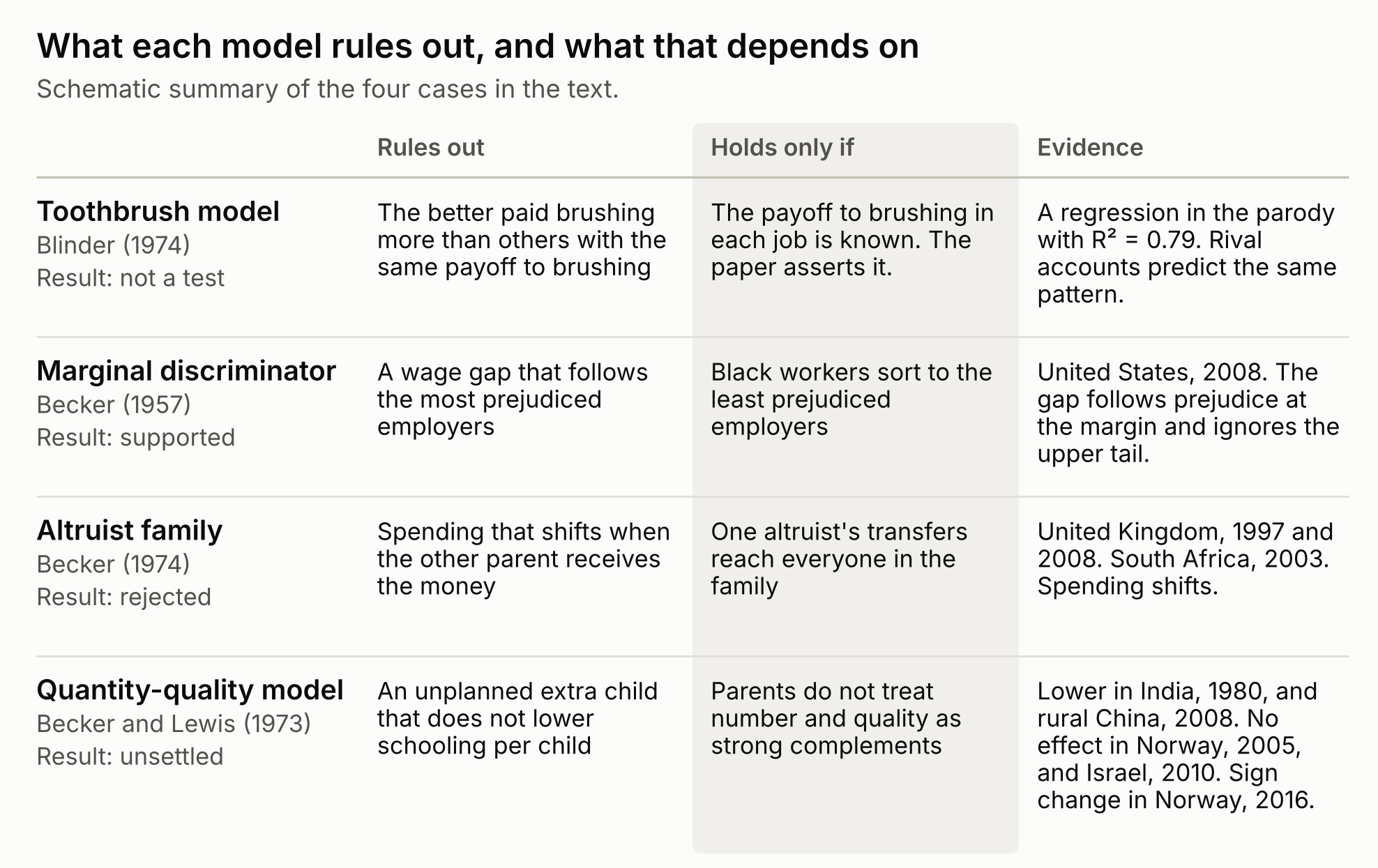
Figure 1. Schematic summary of the four cases. The middle column gives the maintained assumption on which each restriction depends. Evidence is labeled by country and year of publication. Hotchkiss (2005) disputes the 1997 estimate for the United Kingdom.
The teeth
One part of the toothbrush model did get a real test. In “The Economic Value of Teeth,” Sherry Glied and Matthew Neidell (2010) use the spread of water fluoridation across American communities. Fluoridation was decided by local politics, and the authors argue that this makes a child’s exposure unrelated to the other things that determine earnings. Women who grew up with fluoridated water earn about 4 percent more as adults. For men there is no detectable effect. The effect is concentrated among women from poorer families, and the authors find little support for a productivity explanation and some support for discrimination by consumers and possibly by employers. Those are two of the cases Becker analyzed in his dissertation.
Their paper answers a different question from the one in Blinder’s model, and the two are easy to confuse. Glied and Neidell ask whether the labor market pays for good teeth. Blinder’s model says that people choose their dental hygiene in order to maximize what the labor market pays. The first question could be answered because the variation in teeth came from a source the children did not choose. It also supplies what Blinder’s model lacked, a measured payoff to healthy teeth. The second question has still not been tested. A test would need the payoff measured job by job, and a prediction about who brushes that the rival explanations do not share.
The argument about Becker was mostly conducted at the level of the approach. In 1976 he claimed that the economic approach applies to all human behavior. Many of his colleagues thought his topics were not economics at all. Both positions are about the approach, and the approach by itself forbids almost nothing, so the argument could not be settled. The models can be judged one at a time. The model of the marginal discriminator ruled out what most people would have expected, and the data supported it fifty years later. The altruist model also ruled out what most people expected, and there the data went with the expectation, while the models that replaced it kept its question. The quantity-quality model rules something out only once a restriction on preferences is added, and after more than thirty years of estimates the verdict still depends on which maintained assumptions one grants.
Blinder’s parody shows the other possibility, a model with predictions and a good fit whose confirmation tells us nothing. Becker, by Heckman’s account, wanted it published. Becker showed that economics could ask a question about almost anything, including who gets hired, how many children a couple has, and which parent controls the money. He did not show that it could answer all of them. Whether an answer was scientific depended on what the model ruled out, given the assumptions it maintained, and on what happened when someone checked.
Further reading
Angrist, J., Lavy, V. and Schlosser, A. (2010), “Multiple Experiments for the Causal Link between the Quantity and Quality of Children,” Journal of Labor Economics 28(4), 773-824. Twins and sibling-sex instruments in Israeli census data, with no sign of a tradeoff.
Becker, G. S. (1957), The Economics of Discrimination, University of Chicago Press. The dissertation that made the marginal employer the determinant of the wage gap.
Becker, G. S. (1960), “An Economic Analysis of Fertility,” in Demographic and Economic Change in Developed Countries, National Bureau of Economic Research, 209-240. The linked file includes Duesenberry’s comment, which is worth reading in full.
Becker, G. S. (1962), “Irrational Behavior and Economic Theory,” Journal of Political Economy 70(1), 1-13. Shows that downward-sloping demand follows from the budget constraint even when consumers do not maximize.
Becker, G. S. (1974), “A Theory of Social Interactions,” Journal of Political Economy 82(6), 1063-1093. The altruist family and the Rotten Kid Theorem.
Becker, G. S. (1976), The Economic Approach to Human Behavior, University of Chicago Press. The statement of the approach, including the claim that it applies to all human behavior.
Becker, G. S. (1981), A Treatise on the Family, Harvard University Press, enlarged edition 1991. The full program, with an introduction to the enlarged edition that concedes several of the critics’ points.
Becker, G. S. (1993), “Nobel Lecture: The Economic Way of Looking at Behavior,” Journal of Political Economy 101(3), 385-409. Becker’s own summary of the program and of how it was received.
Becker, G. S. and Lewis, H. G. (1973), “On the Interaction between the Quantity and Quality of Children,” Journal of Political Economy 81(2, Part 2), S279-S288. Ten pages that put the product of n and q into the budget constraint.
Bergmann, B. R. (1995), “Becker’s Theory of the Family: Preposterous Conclusions,” Feminist Economics 1(1), 141-150. The most direct statement of the political objection.
Bergstrom, T. C. (1989), “A Fresh Look at the Rotten Kid Theorem--and Other Household Mysteries,” Journal of Political Economy 97(5), 1138-1159. Shows that the theorem fails without transferable utility and gives the exact condition it needs.
Black, S. E., Devereux, P. J. and Salvanes, K. G. (2005), “The More the Merrier? The Effect of Family Size and Birth Order on Children’s Education,” Quarterly Journal of Economics 120(2), 669-700. Norwegian population data in which birth order matters and family size does not.
Blinder, A. S. (1974), “The Economics of Brushing Teeth,” Journal of Political Economy 82(4), 887-891. The parody, five pages long, with a formal model, predictions, and a regression.
Charles, K. K. and Guryan, J. (2008), “Prejudice and Wages: An Empirical Assessment of Becker’s The Economics of Discrimination,” Journal of Political Economy 116(5), 773-809. The first test of the predictions about the marginal discriminator.
Duflo, E. (2003), “Grandmothers and Granddaughters: Old-Age Pensions and Intrahousehold Allocation in South Africa,” World Bank Economic Review 17(1), 1-25. Evidence against pooling from pensions paid to women and to men.
Glied, S. and Neidell, M. (2010), “The Economic Value of Teeth,” Journal of Human Resources 45(2), 468-496. Uses fluoridation as a source of variation in teeth that the people affected did not choose.
Hannan, M. T. (1982), “Families, Markets, and Social Structures: An Essay on Becker’s A Treatise on the Family,” Journal of Economic Literature 20(1), 65-72. A sociologist’s favorable review of the Treatise.
Heckman, J. J. (2014), “Private Notes on Gary Becker,” IZA Discussion Paper 8200. Notes for a 2011 talk, with long excerpts from Duesenberry’s comment and the remarks on Solow and Blinder.
Hitchcock, C. and Sober, E. (2004), “Prediction Versus Accommodation and the Risk of Overfitting,” British Journal for the Philosophy of Science 55(1), 1-34. Proposes that fitting a theory to known facts is a problem only when overfitting goes unchecked.
Hotchkiss, J. L. (2005), “Do Husbands and Wives Pool Their Resources? Further Evidence,” Journal of Human Resources 40(2), 519-531. The challenge to the child benefit result, using couples without children.
Li, H., Zhang, J. and Zhu, Y. (2008), “The Quantity-Quality Trade-Off of Children in a Developing Country: Identification Using Chinese Twins,” Demography 45(1), 223-243. Twins in the 1990 Chinese census, with a tradeoff in rural areas.
Lundberg, S. J., Pollak, R. A. and Wales, T. J. (1997), “Do Husbands and Wives Pool Their Resources? Evidence from the United Kingdom Child Benefit,” Journal of Human Resources 32(3), 463-480. The natural experiment that rejected income pooling.
Mogstad, M. and Wiswall, M. (2016), “Testing the Quantity-Quality Model of Fertility: Estimation Using Unrestricted Family Size Models,” Quantitative Economics 7(1), 157-192. Shows that the Norwegian finding of no effect depends on a linear specification, and that the effect changes sign with family size.
Pollak, R. A. (2003), “Gary Becker’s Contributions to Family and Household Economics,” Review of Economics of the Household 1(1), 111-141. A critic’s assessment written for a symposium in Becker’s honor, and the source of the distinction between foundational and auxiliary assumptions.
Rosenzweig, M. R. and Wolpin, K. I. (1980), “Testing the Quantity-Quality Fertility Model: The Use of Twins as a Natural Experiment,” Econometrica 48(1), 227-240. The paper that turned twin births into a test of the model.
Rosenzweig, M. R. and Zhang, J. (2009), “Do Population Control Policies Induce More Human Capital Investment? Twins, Birth Weight and China’s ‘One-Child’ Policy,” Review of Economic Studies 76(3), 1149-1174. Explains why twin estimates bound the effect of family size without identifying it.
Samuelson, P. A. (1976), “An Economist’s Non-Linear Model of Self-Generated Fertility Waves,” Population Studies 30(2), 243-247. Contains the remark about indifference-curve jargon and the footnote naming Becker and Schultz.
Stigler, G. J. and Becker, G. S. (1977), “De Gustibus Non Est Disputandum,” American Economic Review 67(2), 76-90. The rule against explaining behavior by differences in taste.
Ward-Batts, J. (2008), “Out of the Wallet and into the Purse: Using Micro Data to Test Income Pooling,” Journal of Human Resources 43(2), 325-351. Household-level data on the same reform, with childless couples as a comparison group.
Interesante post, aunque poco claro al respecto de la postura del autor. Entonces, la pregunta sería directa: con respecto al enfoque de Becker, de que la economía, que mejor denominaré como ciencia económica, lo puede estudiar todo, eso podría significar dos cosas: 1) que todo es económico y por ende es objeto de estudio de la ciencia económica, o 2) que el enfoque teórico básico del tipo de ciencia económica que él practicaba, la marginalista, es extensible a todo hecho humano, necesitando únicamente asumir que los actores actúan según los supuestos de ese tipo de ciencia económica. ¿Cuál es su posición al respecto?