
What would have happened if the Federal Reserve hadn’t raised interest rates in 2022?
Policymakers need to answer this. Journalists ask it constantly. Voters have opinions about it. The question is not obscure or academic. It is the kind of question that determines elections and shapes economies.
Now try to answer it using the methods that have come to define credible empirical economics.
A randomized trial? You cannot randomly assign monetary policy across economies. There is one Federal Reserve, one U.S. economy, one 2022.
Difference-in-differences? There is no untreated economy following the same trajectory as the United States, differing only in its central bank’s decisions.
Regression discontinuity? There is no threshold—no rule that says the Fed tightens at exactly 8.5% inflation but not at 8.4%.
Instrumental variables? Any instrument that moves interest rates over conventional horizons also moves expectations, investment plans, hiring decisions. The exclusion restriction is difficult to defend—though not impossible, as we will see.
This is not a contrived example. This is the normal state of affairs in macroeconomics. The questions that define the field—what should monetary policy do, how large are fiscal multipliers, what causes recessions and what ends them—are questions where the standard identification strategies strain against their limits.
Macroeconomists did not choose these questions because they enjoy frustration. They inherited them because these are the questions that matter for policy. And the impossibility of answering them with a clean natural experiment does not make them go away.
The Standard Narrative and Its Problems
The conventional story about empirical economics goes something like this. Microeconomics underwent a credibility revolution. Researchers learned to demand clean identification, to find natural experiments, to be explicit about assumptions. Macroeconomics, meanwhile, remained stuck in a world of structural models with dubious assumptions and reduced-form time series that could not support causal claims.
This narrative contains some truth. The credibility revolution was real. It changed how economists think about causal inference. It produced a generation of researchers who ask hard questions about identification.
But the narrative misunderstands the history of both fields.
Microeconomics in the 1970s was not simply running regressions with controls. It had its own sophisticated structural tradition. Heckman’s selection models, McFadden’s discrete choice framework, Roy models of occupational sorting, structural labor supply estimation—these were serious attempts to recover behavioral parameters from observational data. The assumptions were strong, but they were not hidden. The models were explicit about what they required.
Both fields, in other words, were doing structural economics with strong identifying assumptions. Both fields faced credibility critiques. The difference lies in how they responded—and in which responses were available given the questions each field was trying to answer.
What Sims Was Actually Arguing
Christopher Sims’ 1980 paper “Macroeconomics and Reality” is often remembered as the paper that introduced vector autoregressions. This is true but incomplete. The paper’s deeper contribution was a critique—and the critique applies far beyond macro.
The large-scale macroeconometric models of the 1970s claimed to identify structural relationships. They estimated demand curves, supply curves, policy reaction functions. The models were complicated and impressive-looking. But the identification rested on exclusion restrictions that were assumed rather than defended.
A variable was called exogenous because the modeler said so. A coefficient was set to zero because it simplified estimation. The structure was elaborate, but the foundation was assumption piled on assumption.
Sims’ argument was simple and devastating. If your identifying assumptions are not credible, your structural estimates are not credible either. Calling something exogenous does not make it exogenous. The math cannot rescue you from bad assumptions.
This critique was not unique to macro. Microeconometrics faced the same challenge. Heckman’s selection models required exclusion restrictions—variables that affected selection but not outcomes. Labor supply estimates required functional form assumptions and instruments for wages. The structural micro tradition was rigorous and productive, but it too rested on assumptions that were often difficult to verify.
The credibility revolution in micro—associated with Angrist, Card, Krueger, Imbens, and others—applied the same logic Sims had applied to macro: don’t just assert your identifying assumptions, defend them. The difference was that for certain micro questions, a new class of solutions became available.
How Clean Designs Work—and What They Require
The credibility revolution succeeded by developing research designs where the identifying assumptions were embedded in the structure of the data rather than imposed by the researcher.
A well-designed randomized trial creates treatment and control groups that are comparable by construction. The randomization itself handles selection. The researcher does not need to assume that treated and untreated units are similar—the design guarantees it.
Difference-in-differences exploits the timing of policy changes. If a reform affects some units before others, and if units would have followed parallel trends absent the reform, then the divergence after treatment identifies the causal effect.
Regression discontinuity exploits arbitrary cutoffs. If treatment is assigned based on whether a score crosses a threshold, and if units just above and just below the threshold are otherwise similar, then the jump in outcomes at the threshold identifies the effect.
Instrumental variables exploit exogenous shifters. If something moves treatment but affects outcomes only through treatment, then the variation it induces is as good as random.
These designs are powerful. They discipline researchers. They make assumptions visible.
But they work by narrowing the question to a setting where the assumptions are plausible.
The standard RCT estimator requires SUTVA—the stable unit treatment value assumption. This means no interference between units and no hidden treatment variations. Spillovers can be incorporated with appropriate designs. Miguel and Kremer’s 2004 deworming study estimated spillovers on untreated children near treated schools. Cluster randomization and saturation designs allow researchers to measure local spillovers within the experimental frame.
But general equilibrium effects—changes in prices, wages, interest rates, expectations that propagate through the entire economy—remain outside what an experiment can capture. You can randomize deworming pills across Kenyan schools. You cannot randomize interest rates across parallel universes.
Difference-in-differences requires parallel trends and typically assumes that treatment in one place does not affect outcomes in another. Regression discontinuity identifies effects at the threshold—not the average effect, but the effect for units at the margin. Instrumental variables identify a local average treatment effect—the effect for compliers whose behavior is actually shifted by the instrument.
Each design purchases credibility by limiting scope. LATE tells you about compliers. RD tells you about the cutoff. DiD tells you about the treated, conditional on trends.
This is not a criticism. Narrowing is a legitimate scientific strategy. You learn what the data can teach you, and you are honest about the limits.
But the phenomena that narrowing excludes—aggregate effects, equilibrium responses, forward-looking behavior, economy-wide feedback—are precisely the phenomena that macroeconomics exists to study.
The Divergent Response
The credibility critique hit both macro and micro in the 1980s. LaLonde’s 1986 paper showed that non-experimental estimates of job training programs diverged wildly from experimental benchmarks. Leamer’s 1983 “Let’s Take the Con Out of Econometrics” challenged the profession’s casual attitude toward specification choices. The message was the same as Sims’: assumptions matter, and we are not defending them well enough.
But the fields responded differently—and within micro, different subfields responded differently still.
In labor economics, public finance, and development, researchers found that many questions could be reformulated to exploit natural experiments. The effect of education on earnings? Find a policy that forced some people to stay in school longer. The effect of minimum wages on employment? Compare counties on either side of a state border when one state raises its minimum wage. The effect of health insurance on health? Exploit the randomization in the Oregon Medicaid lottery.
These designs worked because the questions could be narrowed. You were not trying to estimate the aggregate effect of education on GDP. You were estimating the return to an additional year of schooling for people induced to stay in school by a compulsory schooling law. You were not asking what would happen if every country adopted a minimum wage. You were asking what happened in New Jersey relative to Pennsylvania.
Industrial organization took a different path. Berry, Levinsohn, and Pakes (1995) developed methods for estimating demand in differentiated product markets—methods that were deeply structural, required functional form assumptions, and did not rely on natural experiments. The questions IO asked—how would a merger affect prices, how does market structure affect innovation—required understanding substitution patterns and strategic behavior across the entire market. These could not be answered by finding a discontinuity.
Macroeconomics had even less room to narrow. The questions that define the field—what should the Fed do, how large is the fiscal multiplier, what caused the Great Recession—are inherently about aggregates. You cannot find a regression discontinuity in monetary policy. There is no control group of economies that did not experience the 2008 financial crisis.
So macro developed a different toolkit—not because macroeconomists were hostile to clean identification, but because their questions did not permit it.
The Macro Toolkit
Valerie Ramey’s 2016 handbook chapter provides the most comprehensive survey of how macroeconomists identify causal effects. The methods are diverse, but they share a common logic: find variation that is plausibly exogenous to current economic conditions, and use it to trace out causal effects.
Narrative identification reads the historical record to isolate policy changes that were not responses to the economy. Romer and Romer’s 2004 work on monetary policy isolates rate changes that cannot be predicted by the Fed’s own internal forecasts of economic conditions. By regressing policy decisions on the Greenbook forecasts and extracting the residual, they remove the endogenous component—what remains is plausibly a shock to policy preferences rather than a response to the economy. Ramey’s 2011 work on fiscal policy uses Business Week articles to identify defense spending changes announced before they could affect the economy.
High-frequency identification exploits the fact that macroeconomic conditions do not change in very short windows. Nakamura and Steinsson’s work measures the effect of FOMC announcements using interest rate movements in 30-minute windows around the announcement. In half an hour, output and employment do not change. Whatever moves in that window is plausibly a monetary shock.
External instruments—what Stock and Watson call proxy SVARs—use variables correlated with the shock of interest but uncorrelated with other shocks. This is the macroeconomic counterpart of instrumental variables. The identifying assumptions are the same: relevance and exogeneity.
Sign restrictions, developed by Uhlig and others, take a different approach. Instead of assuming you know which variables are excluded, you assume only the direction of effects—a contractionary monetary shock does not raise output or lower rates on impact—and ask what can be learned under this minimal structure.
These methods differ in their details. But they share an underlying discipline: state your assumptions explicitly, defend them with evidence and argument, trace out what they imply and what they cannot tell you.
Plagborg-Møller and Wolf’s 2021 paper proved something that clarified the field. Local projections and vector autoregressions—methods that had seemed like competing paradigms—estimate the same impulse responses. They are different estimation strategies for the same object, with different finite-sample properties. The methodological divide was smaller than it appeared.
Macro’s Own Credibility Problems
None of this should suggest that macroeconomics solved its identification problems. It did not.
The narrative methods require judgment calls about what counts as an exogenous policy change. Romer and Romer’s reading of the historical record involves classification decisions that other researchers might make differently. Ramey’s defense news shocks depend on when markets first learned about spending changes—a question that rarely has a clean answer.
High-frequency identification assumes that nothing else moves in the event window. But FOMC announcements may reveal information about the Fed’s private assessment of the economy, not just about policy intentions. Nakamura and Steinsson themselves document this “Fed information effect”—when the Fed raises rates, markets sometimes revise upward their expectations for growth, suggesting the announcement conveyed good news about fundamentals. Separating the policy shock from the information shock requires additional structure.
The structural models that dominate academic macro have their own problems. Many DSGE parameters are weakly identified—the data cannot distinguish between different configurations of the model. Likelihood surfaces are often flat in important dimensions. Researchers choose calibration targets partly for convenience. The invertibility assumption—that the econometrician observes enough to recover the structural shocks—fails in models with news, signals, or richer information structures than the VAR contains.
Fernández-Villaverde, Rubio-Ramírez, and Schorfheide have documented these identification failures systematically. The problem is not that structural macro uses assumptions. The problem is that the assumptions are sometimes untestable, the identification is sometimes weak, and the conclusions are sometimes fragile to specification choices that the papers do not emphasize.
Macro did not escape the credibility critique. It lived under that critique from the beginning—and continues to struggle with it. What macro developed was not a solution but a stance: acknowledge the difficulty, be explicit about assumptions, present results across specifications, and resist false confidence.
This is a lower bar than “clean identification.” It is also, given the questions, perhaps the only honest bar available.
The Cracks in the Workhorse
For two decades, two-way fixed effects with staggered treatment timing was the default method in applied microeconomics. A policy rolls out in different places at different times. You include unit fixed effects and time fixed effects. The coefficient on treatment is your causal estimate.
The method was intuitive, flexible, and widely trusted. Thousands of papers used it.
Then Andrew Goodman-Bacon published his decomposition.
The 2021 paper showed that two-way fixed effects estimates are weighted averages of all possible two-by-two comparisons in the data. Some comparisons use never-treated units as controls. But other comparisons use already-treated units as controls for newly-treated units.
When treatment effects change over time—when the effect grows, or fades, or differs across cohorts—these already-treated controls can enter the weighted average with negative weights. The estimate can be positive even when the true effect is negative for every unit.
Sun and Abraham showed that standard event study specifications suffer from the same problem. de Chaisemartin and D’Haultfœuille generalized the result. What had seemed like a transparent, assumption-light method was concealing strong assumptions about treatment effect homogeneity.
The assumptions were always present. Parallel trends was stated in every paper. But two-way fixed effects also assumed that already-treated units remain valid controls, that treatment effects do not vary systematically across cohorts, and that the timing of treatment is unrelated to the trajectory of effects.
These assumptions were embedded in the estimator, not displayed in the identification section. Researchers using the method did not realize what they were assuming because the assumptions were hidden in the mechanics of the regression.
What is striking about this episode is that the problems were not entirely new. They belonged to a family of difficulties that macroeconomists had encountered under different names. How do you aggregate across heterogeneous units? What happens when the timing of shocks varies? How do you combine estimates from different subgroups when effects differ?
The VAR literature had confronted related issues in the context of shock identification and impulse response aggregation. The specific problems differed—TWFE’s negative weights are not the same as VAR ordering assumptions—but the general challenge of hidden assumptions about homogeneity and timing was familiar territory.
When microeconomics scaled up to questions with staggered timing and heterogeneous effects, it encountered difficulties that rhymed with what macro had faced. The DiD crisis was not exactly the same pathology. But it was a cousin—arriving in a field that had believed its methods were assumption-light.
From Identified Moments to Aggregate Answers
Nakamura and Steinsson’s 2018 survey article, “Identification in Macroeconomics,” articulates the convergence more clearly than anyone.
Their argument is that modern macro identification increasingly resembles micro identification. High-frequency event studies. Cross-sectional variation in exposure to aggregate shocks. Narrative measures as instrumental variables. The logic is the same: find plausibly exogenous variation and trace out its effects.
But they also emphasize a problem that micro is only beginning to confront. How do you go from a cleanly identified local estimate to an aggregate answer?
Their own work on fiscal multipliers illustrates the challenge. In Nakamura and Steinsson (2014), they estimate how regional output responds to regional military spending. When a national defense buildup increases spending disproportionately in California, how much does California’s output rise relative to other states?
The identification is excellent. Defense buildups are driven by geopolitics, not California’s business cycle. The geographic concentration of defense contractors is historically determined. The cross-state variation is plausibly exogenous to local conditions.
The regional multiplier is around 1.5—output rises by $1.50 for every dollar of additional military spending.
But what does this tell us about the aggregate fiscal multiplier—the effect of national stimulus on national GDP?
Not directly. The regional regressions include time fixed effects, which absorb the aggregate response. Any effect that operates through interest rates, exchange rates, or economy-wide expectations is differenced out. The regional estimate and the aggregate multiplier are different objects.
To go from the regional estimate to an aggregate prediction, you need a model. The regional evidence disciplines the model—it must generate a regional multiplier of 1.5 to be credible. But the model does the aggregation, incorporating the general equilibrium effects that the regional regression removes.
This is where the two traditions meet. Micro provides the identified moment—the cleanly estimated local effect. Structure provides the aggregation—the framework for moving from local to aggregate. Neither alone answers the policy question. Together, they might.
Just Enough Structure
Martin Beraja’s 2023 paper formalizes what was implicit in the best macro practice and connects it to ideas that micro embraces under different names.
The Lucas critique haunts policy analysis. If you change policy, private behavior changes. Relationships estimated under one regime do not hold under another. Therefore, you need a structural model with deep parameters that remain stable when policy shifts.
This argument reshaped macroeconomics. But Beraja shows that it proves less than it seems.
Consider three different New Keynesian models. The standard textbook version. A behavioral variant where agents are inattentive to macroeconomic conditions. A working capital version where firms borrow to finance production. Different microfoundations, different assumptions about how agents think and firms operate.
All three models can be calibrated to match the same data under the current monetary policy rule. They are observationally equivalent—the data cannot tell them apart.
Now change the policy rule. What happens?
The textbook model and the behavioral model generate the same counterfactual prediction. Despite their different microfoundations, they agree about what alternative policy would do. The working capital model generates a different prediction.
Beraja calls this counterfactual equivalence. Many models that fit the current data also agree about counterfactuals. Not all models—but many. The set of models you must distinguish between is smaller than it first appears.
His theorem makes this precise. To identify a policy counterfactual, you do not need to specify all parameters of a complete structural model. You need enough restrictions to pin down the objects that matter for the counterfactual—but no more.
This is an old idea with a new formalization. Marschak, at the Cowles Commission, argued that policy analysis does not require full identification of all structural parameters. It requires identification of the combinations that matter for the policy question. Beraja shows exactly how many restrictions are needed and what form they must take.
The parallel to microeconomics is direct. Chetty’s 2009 work on sufficient statistics makes the same argument for welfare analysis. To evaluate the welfare effects of a tax change, you do not need to estimate the entire demand system. You need the elasticities that enter the welfare formula. Identify what matters. Ignore what does not.
Sufficient statistics in micro. Semistructural counterfactuals in macro. The same insight, expressed in different languages: figure out what you need to know to answer the question, and focus your identification efforts there.
Two Traditions Converging
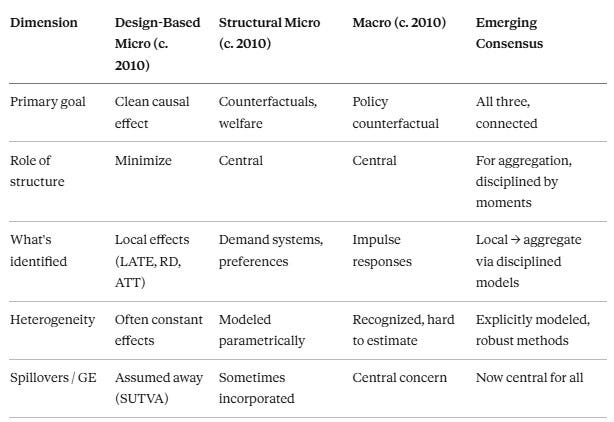
The division between structural and reduced-form was never as clean as methodological debates suggested. Every reduced-form estimate relies on assumptions. Every structural model must match data.
What is happening now is a recognition that the two approaches answer different parts of the same question.
Clean identification provides credible local estimates. Structure provides the framework for aggregation and counterfactual analysis. The local estimates discipline the structure. The structure extends the local estimates to objects of policy interest.
The applied micro fields that embraced design-based methods are now learning what structural IO and macro always knew: local estimates do not automatically aggregate. The regional fiscal multipliers cannot answer questions about national stimulus without a model. The effects of local minimum wage increases cannot tell you about national policy without accounting for worker mobility and firm relocation. The housing wealth effects estimated from geographic variation cannot predict aggregate consumption responses without modeling interest rates and credit conditions.
Macro learned this earlier because it had no choice. The questions it faced never permitted clean identification in the first place. The challenge was always to combine partial evidence with disciplined structure.
The DiD crisis accelerated the convergence. When applied researchers discovered that their trusted methods embedded hidden assumptions about heterogeneity and dynamics, they rediscovered a class of problems that time series econometricians and structural microeconomists had wrestled with for decades. The specific issues differed, but the underlying lesson was the same: there is no assumption-free estimation. The question is always which assumptions you are making and whether they are defensible.
What Remains
The credibility revolution was not a wrong turn. It raised standards for causal claims. It made identification an explicit topic of discussion. It forced researchers to confront the gap between correlation and causation.
But the narrative that macroeconomics failed to participate in this revolution misreads history.
Both macro and micro had structural traditions in the 1970s. Both faced credibility critiques in the 1980s. The difference was not in intellectual standards—it was in the available responses.
For many micro questions, researchers could narrow the scope to settings where design-based identification was feasible. For macro questions, this was rarely possible. The economy is the unit of observation. There is no control group for monetary policy.
This forced macro into a different relationship with structure. Not the old, incredible structure of the 1970s—full models with hundreds of equations and assumptions hidden in every coefficient. Instead, a more modest structure: enough to aggregate, enough to do counterfactuals, disciplined by whatever identified moments the data provide.
Parts of micro maintained structural approaches throughout—industrial organization never abandoned them. And now, as the design-based wing of micro takes on more ambitious questions—national policies, long-run effects, general equilibrium responses—it is converging toward the same synthesis.
The path forward is not a choice between paradigms. It is a recognition that different tools answer different parts of the question. Credible identification provides the foundation. Disciplined structure provides the aggregation. Neither alone delivers what policy requires.
Macro asked these questions first because it had no alternative. Micro is asking them now because its ambitions have grown. The convergence is not a retreat from rigor. It is an expansion of what rigor means—from the question of whether an effect exists to the question of what that effect implies.
Some Readings
The Macro Identification Tradition
Sims, C. (1980). “Macroeconomics and Reality.” Econometrica. The original critique that reshaped empirical macroeconomics.
Blanchard, O. & Quah, D. (1989). “The Dynamic Effects of Aggregate Demand and Supply Disturbances.” American Economic Review. Long-run restrictions as a source of identification.
Romer, C. & Romer, D. (2004). “A New Measure of Monetary Shocks.” American Economic Review. Narrative methods applied to monetary policy.
Uhlig, H. (2005). “What Are the Effects of Monetary Policy on Output?” Journal of Monetary Economics. Sign restrictions and agnostic identification.
Ramey, V. (2016). “Macroeconomic Shocks and Their Propagation.” Handbook of Macroeconomics. The comprehensive survey of identification methods.
Stock, J. & Watson, M. (2018). “Identification and Estimation of Dynamic Causal Effects in Macroeconomics Using External Instruments.” Economic Journal. External instruments and proxy SVARs.
Identification Challenges in Structural Macro
Fernández-Villaverde, J., Rubio-Ramírez, J., & Schorfheide, F. (2016). “Solution and Estimation Methods for DSGE Models.” Handbook of Macroeconomics. The comprehensive treatment of identification and estimation challenges.
Plagborg-Møller, M. & Wolf, C. (2022). “Instrumental Variable Identification of Dynamic Variance Decompositions.” Journal of Political Economy. Bounds under weak identification and non-invertibility.
The Structural Micro Tradition
Heckman, J. (1979). “Sample Selection Bias as a Specification Error.” Econometrica. The selection model that shaped a generation of structural work.
McFadden, D. (1974). “Conditional Logit Analysis of Qualitative Choice Behavior.” Frontiers in Econometrics. The foundation of discrete choice analysis.
Berry, S., Levinsohn, J., & Pakes, A. (1995). “Automobile Prices in Market Equilibrium.” Econometrica. Structural IO’s response to the credibility critique.
The Micro Credibility Revolution
LaLonde, R. (1986). “Evaluating the Econometric Evaluations of Training Programs with Experimental Data.” American Economic Review. The paper that launched a thousand natural experiments.
Angrist, J., Imbens, G., & Rubin, D. (1996). “Identification of Causal Effects Using Instrumental Variables.” JASA. The framework that defined LATE.
Miguel, E. & Kremer, M. (2004). “Worms: Identifying Impacts on Education and Health in the Presence of Treatment Externalities.” Econometrica. Measuring spillovers within an experimental design.
Angrist, J. & Pischke, J.-S. (2010). “The Credibility Revolution in Empirical Economics.” Journal of Economic Perspectives. The retrospective.
The DiD Crisis
Goodman-Bacon, A. (2021). “Difference-in-Differences with Variation in Treatment Timing.” Journal of Econometrics. The decomposition that revealed the problem.
Sun, L. & Abraham, S. (2021). “Estimating Dynamic Treatment Effects in Event Studies with Heterogeneous Treatment Effects.” Journal of Econometrics. Problems with standard event studies.
de Chaisemartin, C. & D’Haultfœuille, X. (2020). “Two-Way Fixed Effects Estimators with Heterogeneous Treatment Effects.” American Economic Review. The general characterization.
The Synthesis
Nakamura, E. & Steinsson, J. (2014). “Fiscal Stimulus in a Monetary Union: Evidence from U.S. Regions.” American Economic Review. Regional multipliers and the aggregation problem.
Nakamura, E. & Steinsson, J. (2018). “Identification in Macroeconomics.” Journal of Economic Perspectives. The clearest statement of convergence.
Plagborg-Møller, M. & Wolf, C. (2021). “Local Projections and VARs Estimate the Same Impulse Responses.” Econometrica. Methodological unification.
Beraja, M. (2023). “A Semistructural Methodology for Policy Counterfactuals.” Journal of Political Economy. Just enough structure for counterfactuals.
Chetty, R. (2009). “Sufficient Statistics for Welfare Analysis: A Bridge Between Structural and Reduced-Form Methods.” Annual Review of Economics. The bridge between traditions.